8 Ways Artificial Intelligence (AI) Is Being Used in Web Development

Having an intuitive online presence is crucial for the success of the organization of any domain. Businesses have realized it and are opting for stunning and easy-to-navigate websites. It not only improves their online presence but provides opportunities for generating more revenue.
Developers leverage cutting-edge programming frameworks and tools to deliver websites that exceed business owner’s expectations. They ensure that a website is user-friendly, responsive, fast-loading, etc. But all this requires time.
Website designers and developers were looking for ways to automate processes without dropping the quality of websites. AI in web development has emerged as a solution to enhance website quality and overcome its challenges.
Today, the ways of designing and developing user-friendly websites have entirely changed because of the advent of AI. It enhances the productivity of designers and developers. According to a GitHub survey, an astonishing 92% of US developers use AI coding tools to help them with their work.

This article will discuss how artificial intelligence impacts web development. But before that, let’s look into how AI in web development enhances the productivity of developers and the top AI tools for web development.
How AI in web development enhances the productivity of developers
AI in web development has the potential to transform the way developers design and develop websites. It significantly enhances the developer’s productivity by automating mundane tasks. Here is how AI improves the web development process:
1. Know Customer Better
What do you think is the most important thing to know when converting visitors into customers? You might have guessed it right: better understanding of your user behavior. AI tools understand the user’s patterns and give invaluable insights from user data. It allows developers to offer personalized experiences to enhance their satisfaction and nurture meaningful connections with them.
2. Saves Time
AI in web development significantly saves time by automating tasks like code completion, generating code snippets, identifying performance issues, and more. Not only does it save time during code completion, but it also saves time while debugging code. They can invest this time in more crucial development processes.
3. Performance Optimization
Imagine an assistant that analyzes the performance of a website, including loading speed, mobile responsiveness, and more. Won’t it ease the developers and improve their efficiency? That’s what AI in web development brings to the table. AI also assists in optimizing code by providing code quality recommendations to developers.
4 Best AI Tools for Web Development
AI tools are being utilized in web development to remove redundant processes, enhance productivity, and streamline processes. Here are some of the best AI tools for web development that you must try:
1. GitHub Copilot
GitHub Copilot is the best tool that auto completes the code and provides real-time suggestions to improve the code. It is especially helpful when it comes to identifying bugs and resolving them. It enhances the productivity of developers by automating the coding. It also generates documentation by understanding the code.
What’s more, it offers multi language support that enables developers to utilize it for different programming frameworks, including JavaScript, Python, and more.
2. TensorFlow
Many of you might be familiar with TensorFlow. It is one of the most used open-source AI/ML tools among developers. One of the reasons behind its success is its flexible architecture that aids developers in developing, training, and implementing AI models.
Some key features of TensorFlow that make it the go-to AI tool are efficient working with multi-dimensional arrays, computation scalability, and support of deep neural networks.
3. Adobe Sensei
It would be an injustice to talk about the best tools that enhance the designer’s and developer’s productivity and not include Adobe Sensei. It is one of the top AI tools that elevates the digital experience by automating the design process.
This tool is not just for web designers and developers but also marketers and content creators. Its ability to automate image editing, predictive analytics, and content intelligence shows the true impact of AI in web development. It provides intelligent insights and accelerates workflows to save significant time for users.
4. Wix ADI
Another invaluable tool that showcases the impact of AI tools on web development is Wix ADI. It has the ability to create tailored websites depending on the inputted data or query.
All you have to do is provide some crucial information about your desired website, including its purpose, features, and more. Moreover, its capability to integrate content from the web makes it an outstanding option to use for making the web development process smooth.
8 Exciting Ways of Using AI in Web Development
The potential of artificial intelligence isn’t limited to any specific industry or task. It has hundreds of advantages to offer in every aspect. However, choosing a leading and reliable AI development company matters a lot. It empowers you to get your desired website while leveraging the capabilities of AI at the same time.
Here are different ways of using AI in web development:
1. Faster Coding
Undoubtedly, coding requires a lot of effort and time to deliver the best results. Developers were looking for a solution that could assist them and improve the web development process.
Today, several AI assistants and tools are available that have made coding a breeze. These tools and assistants automate the website development processes. By doing so, AI reduces the time to build intuitive websites without compromising the quality.
2. Personalized User Experiences
According to a report, 90% of leading marketers say that personalization contributes to business profitability. This massive number indicates the significance of prioritizing user experiences.
AI algorithms have the ability to analyze user browsing history, preferences, and other insights to deliver tailored recommendations and user experiences. It significantly improves user engagement, increases loyalty, and enhances sales.
3. AI Chatbots for Engagement
Did you ever have a coincidence of seeing a pop-up appearing on a website with an aim to start a conversation with you? These are smart AI chatbots in action. These AI chatbots are available 24/7 to answer user queries, provide information, search relevant items, and even schedule appointments.
AI chatbots are a great way of engaging users even at night when it is not possible for a human agent to resolve the queries of users. These AI chatbots have eased humans by reducing the workload. These chatbots satisfy users by resolving their concerns, which opens up new opportunities for converting them into customers.
4. User Behavior Analysis
Users are the lifeblood of any business. Happy users mean one step forward towards a successful business. Websites, being the first point of interaction, hold significant importance. It is necessary to improve the website design or content if required. But how to know whether your users are satisfied?
Several AI-driven tools are available that provide insights about how users interact with your website. These insights provide you with information about user satisfaction and the website areas for improvement. It empowers developers to make necessary changes and increase user trust and loyalty to your brand.
5. Prototyping
Prototyping is of the utmost importance in the website development process. It offers a visual representation of the layout and functionality of the website. Additionally, it reduces the risks of any ambiguity earlier in the development process. However, it requires a lot of time to prototype.
AI in web development accelerates the process of website prototyping. It empowers designers to refine the prototype conveniently and quickly. AI also considers user sentiments and industry standards during the prototype process. It saves time and enhances the user experience to generate more revenue.
6. Voice Search Optimization
Voice search is the new meta. It has gained significant attention over the years. Businesses are looking to take advantage of this functionality by adding it to their websites. AI aids in making this feature a success.
How? AI understands voice messages and replies with the most appropriate search results. It significantly enhances user satisfaction and helps to build long-term relationships.
7. Automated Testing
If you have some experience with developing, you must know that finding a syntax error can take upto hours. Debugging is hectic and time-consuming. However, several AI tools have emerged that made it easy to debug code within seconds. It allows your code to run smoothly and removes any performance concerns as well.
8. Better SEO
Many businesses made the mistake of overlooking SEO. You must avoid this mistake by prioritizing SEO equally as important as coding during the web development process. After all, what’s the point of developing a website when it won’t reach its targeted audience?
Additionally, changing search engine algorithms are focusing on user intent and semantic SEO. It is a time-consuming and exhausting job to do. Moreover, it isn’t the task of only a single person; you require a proper team to do the job, which can be costly.
Don’t worry; AI has saved you and developers from the hassle of managing SEO. Several AI tools are available that help to optimize your website, thus increasing the organic traffic. Not only will your website rank higher in search engines, but it will also drive conversion.
How does web development benefit your business?
Your website can be the first point of contact for your potential client. The first impression that you give about your business via the website must be positive. Why? Because it helps them have a perspective of how good you and your services will be.
A good website helps to attract and engage visitors and convert them into customers. Here are some benefits of having a website:
1. Enhanced Visibility & Accessibility
The importance of web development can never be overstated. It breaks the barriers of geographical boundaries and makes it 24/7 accessible to everyone around the globe. It acts as a digital storefront that provides information about your offerings. But can a mere website do the trick? Your website must be user-friendly and easy to navigate to turn your visitors into potential clients.
2. Brand Consistency
The ability to create a consistent brand identity shows why website development is important. It means you can have the same branding across all digital platforms. But how is it possible? You can add colors, logos, and more to the web design to make it perfectly match your identity and values. Having a well-designed website offers a professional look and improves the brand’s authenticity.
3. Better Sales
When internet users can reach out to you from around the world and can see the brand consistency throughout the platforms, it helps to increase sales opportunities and generate more revenue. A well-designed and fully functional website makes a difference in attracting more visitors. It allows businesses to showcase their products or services to engage potential customers, thus increasing the chances of more sales.
4. Competitive Advantage
Having a website plays a crucial role in the making of a business. It is more than just having a digital presence. Website development gives a competitive advantage to your businesses as your customers can easily reach out to you. Moreover, you can utilize digital marketing and SEO techniques to improve search engine ranking and attract your targeted audience. It provides untapped opportunities for growth and gives you a competitive edge over rivals.
Will AI replace web developers?
If you are a developer or a software engineer, you must have pondered whether AI will replace developers or engineers. The simple answer is No. AI won’t replace web developers or software engineers. It acts as an assistant to enhance their productivity and ease them to focus on core aspects.
AI in web development is capable of automating mundane tasks but is not able to start a project from scratch and complete it. It isn’t able to think creatively and solve complex problems outside of the constraints of AI models.
To delve deeper into emerging trends, check out this article on the future of software development: Software Development Trends.
Conclusion
Artificial intelligence has transformed the web development process. It has empowered designers and developers to develop secure, user-friendly, and responsive websites to engage audiences. AI in web development saves time and provides opportunities for sustainable business growth. Several new AI tools will emerge with further advancements in technology and will reshape the web development and design processes.
What else to read?
- What Is the Best Tech Stack for Your Mobile App in 2024?
- Best Mobile App Development Tools for iOS & Android
- Cracking the Code: 11 Crucial Components of a High-Performance Tech Stack
- Complete Guide to Mobile App Development: Process, Trends, Costs
- 8 Tips for Choosing the Right Backend Tech Stack for Your Next Project
When it comes to web reporting, the main focus is on the performance and functionality of your software. Still, visual styling can also positively impact your reports or dashboards. It can enhance key points, highlight hierarchy, and even give you the vibe of the epoch.
Our pivot table component comes with eight predefined themes, but sometimes, it’s not enough to create a unique style or to adapt to your existing brand style. Webdatarocks has great potential for customization of your report as you need. To prove it, we participated in the CodePen challenge dedicated to styling. We wanted to show that our component can be a part of any style solution, no matter how diverse or creative. And what better way to do that than to join a challenge that tests your coding skills and imagination?
But first, a little bit about what Codepen challenge is.
CodePen gives you a new task every week based on a monthly theme. We decided to try the November challenge about Style Trending, which covered such styles as Bento Style, Neo-Brutalism, Y2K Style, and the Gradient Glow Style. The template included the very basics of a fitness app dashboard and style was on us.
Bento Style
The first task was about Bento Style, an ode to digital minimalism. This style emphasizes simplicity, order, and elegance. It is not overloaded with details, so it gives full focus on your data to get valuable insights from it. In our demo, we did exactly that. Our dashboard echoes the Japanese art of bento box arrangement with simplicity and no mess. Each element is where it is supposed to be without any unnecessary decorative elements. Everything is clear, intuitive, and easy to understand, living up to the “less is more” principle.
This style can be excellent for data reporting and analytics thanks to its structural and stylish presentation of information.
Use cases: BI dashboards, financial and executive reports (highlights key insights).

Neo-brutalism
The next style was Neo-Brutalism, so we switched from elegant/structural minimalism to a rebellious style. This style takes its roots from the “raw” brutalist architecture of the 50s-80s, which you can see in hard shapes and strict lines. Nowadays, this style is about bright colors, clean lines, bold fonts, and geometrical shapes.
We managed to implement all this in our demo, which was inspired by Rubik’s Cube. Our dashboard features eye-catching geometric shapes and a vibrant color palette, making the data stand out.
Use cases: Public awareness campaigns, social impact dashboards, scientific visualizations ( it helps to make a strong impression and highlight the contrast between different data segments.).

Y2K Style
The third style was Y2K Style great style for old schoolers that works almost as a time machine and makes you nostalgic. It’s the place where the analog and digital worlds meet – bright colors, bold fonts and patterns, and a modern twist.
This style can be fun and engaging for web reporting and data visualization, especially if you want to target a younger or more nostalgic audience. It can also add some humor and personality to your data presentation. It can give the feeling of the early 2000s era.
Use-cases: marketing, educational, social media and trends reports( to give the vibe of the 2000s and retro it can help soften complex data, and increase user interaction)
Begin to time travel with this demo.

Gradient Glow Style
Our final stop was Gradient Glow Style. This modern trend, rooted in early web design, adds depth and vibrancy to digital spaces. Explore the dashboard, capturing attention with a deep green gradient and matcha-colored accents that soften the seriousness of the report.
It can also help you emphasize the most important data points using colors and gradients.
Use cases: investment dashboards, market research web reports ( it can help make data hierarchy more understandable, improves comprehension.)
Here is our demo to check.

Conclusion
No matter what style you need, the WebDataRocks pivot grid can be customized to it. Explore more examples in our CodePen collection. This is not all customization opportunity, WebDataRocks can also integrate with third-party charting libraries, such as amCharts, Highcharts, Google Charts, or FusionCharts. This way, you can create both eye-catching and interactive data visualizations. If you want to learn more about how to do that, check out our list of tutorials below.
What else to read?
- How to make annual report with WebDataRocks
- Trick or Pivot! Interactive Demos on this Halloween
- Tutorial: How to create a dashboard with WebDataRocks and AnyChart
- Data visualization with WebDataRocks & Chart.js: create a dashboard in 5 min

Webhooks work as an integral part of web development as it helps in facilitating real-time communication between two applications. The objective of this comprehensive guide is to demystify the process of exploring the functionality, implementation, and various use cases in the development arsenal.
What are Webhooks?
Webhook is an approach that helps one system notify another system about events occurring in real time instead of a traditional API process where data needs to be pulled at intervals. Webhook is an automated way that pushes the data automatically when specific events occur.
The event-driven architecture of Webhook enables seamless integration between different services and software applications by triggering data based on event occurrence.
How do Webhooks Work?
Once you’ve got to know “What are Webhooks? Exactly, now let’s talk about its working procedure by jumping down your eye-ball a little on the below content.
Centrally, a webhook contains two main components for its functioning: a sender and a receiver. The sender sends an HTTP request to a predefined URL (called webhook endpoint) whenever an event occurs. On the other hand, the receiver processes the incoming data and takes an appropriate action based on the event payload (information that one URL sends to another).
The Key Components of a Webhook Functioning
Here are the following key components of the webhook that help the webhook platform function. Let’s upgrade your knowledge on each separately.
- Event Source:
Event Source refers to the system that creates events, like a new message or a status change, prompting the webhook to activate. Basically, it is the origin of the trigger that sets the webhook in motion.
- Event Payload:
Payload is the data that gets transmitted during the event in the form of context and information.
- Webhook Endpoint:
The Webhook endpoint is the (second) URL where the event data is sent.
- Subscriber or Listener:
The subscriber or listener is the system or application that receives and processes the incoming data.
How to Implement Webhook?
To get to know how you can implement the process of webhook and start its functioning, here are some of the initial steps:
- Create a Webhook Endpoint: Explain this point in simple terms:
To create the endpoint of the webhook, first, the developers need to set up a designated web address where a server can receive data (payload) automatically. Additionally, allows seamless communication between two software applications or systems. For security purposes, webhooks use HTTPS and request a verification process.
- Event Payloads:
In webhook, when an event happens, as a new message or a status gets changed, then that data is sent in a structured format called JSON to a predefined location. Not only that, it also provides details about what occurred for further processing or action. The action of the payload will not be the same every time, instead, it will vary based on the webhook’s purpose and the services involved.
- Handling Webhook Requests:
In handling the webhook request, the application inspects the incoming data requests to extract the relevant information. Later, the application acknowledges the receipt of data by sending HTTP status codes as confirmation of the events triggered by the webhook.
How is a Webhook Beneficial For You?
Webhooks offer a powerful and efficient way to enable real-time communication between two applications. In addition, webhooks automate the workflows and enhance the overall performance and reliability of software applications and systems.
- Real-Time Updates:
Webhooks is an ideal application since it provides instantaneous updates to applications that require real-time data, like messaging apps or collaborative tools.
- Automation and Integration:
Webhook provides efficiency to the interconnected systems and automates the workflows by triggering actions in response to specific events.
- E-commerce and Payments:
With the webhook, applications like Paytm, Shopify, and more receive instant notifications for order placements, payments, and shipping updates. Moreover, it ensures timely actions as well as communication.
- Customization:
Webhook enables developers to customize the webhook payloads. This flexibility of webhooks allows developers to transfer the data efficiently. Furthermore, it helps reduce the amount of unnecessary data that gets transmitted between two systems.
- Scalability:
Webhooks are so scalable as they have to trigger the request instantly to one system, get a response from another, and make the workflow efficient. Not only that, but also, webhook handles the events’ occurrence without putting unnecessary strain on the system and by supporting scalability in both small and large-scale applications.
- Enhanced Security:
You have no need to worry about security while using Webhook as it offers encryption and authentication mechanisms that ensure the protected data exchanged between systems. However, in the polling mechanisms, it is crucial to maintain the integrity and confidentiality of sensitive information.

Do you want to be the first to test the grid with your data?
- Reliability:
As in the prior time, polling mechanisms were used where reliability was very low. However in the webhooks process, the process is more reliable because it initiates communication only when events occur. Therefore, webhook ensures that only relevant information is delivered promptly without the risk of missed updates or delays.
- Social Media Integration:
Webhooks help social media platforms, like Facebook, Twitter, and more, to respond automatically when certain events occur, like new posts, comments, or gaining new followers. This makes the integration process easier by integrating social media activities with other applications or systems.
- Alerts and Notifications:
Since the webhooks work so quickly and offer great services for sending immediate alerts or notifications when important events happen. The category of the important event includes system failures and other issues, security problems, important updates, and more. Therefore, the speed action of webhooks ensures timely awareness and operation in response to critical situations.
- Reduced Latency:
Webhooks provide instant updates that significantly help reduce latency compared to polling-based approaches. This is very useful, particularly in scenarios where timely information is critical, such as financial transactions, stock updates, or real-time monitoring systems.
Conclusion
Webhooks allow two applications to communicate with each other with complete security by providing a strong solution for real-time integration as well as automation. Webhook is an all-in-one solution for developers. Consequently, helps to understand the architecture, implementation, and potential use cases of webhooks. As the digital landscape continually increases, webhooks play a crucial role in shaping the interconnected nature of modern web development.
What else to read?
- Best Mobile App Development Tools for iOS & Android
- Cracking the Code: 11 Crucial Components of a High-Performance Tech Stack
- Complete Guide to Mobile App Development: Process, Trends, Costs
- How to choose Best React Native Local Database for Smart Applications
- Selecting the Tech Stack for the Web Architecture: Innovative Tools for the Successful Product
- Best Code Editors For Web Development – The Ultimate Latest List

Whether you’re developing software, web apps, or websites, you need a high-performing tech stack as a reliable tool. If you create them often, then it’s even more vital that you have built a tech stack for you.
With that in mind, here are some components your tech stack should have if you are a developer.
1. Robust Infrastructure
At the heart of any decent tech stack is a robust infrastructure that’s reliable and easy to navigate. Although we said, it’s the heart of a tech stack, a rich infrastructure forms the foundation of this tech stack like a backbone, ensuring that the software performs optimally and meets the demands of users.
A high-performance tech stack comprises various components, including programming languages, frameworks, libraries, and databases. However, even the most advanced technologies can only fall short with a solid infrastructure to support these components.
So, what exactly constitutes a robust infrastructure? It encompasses several vital elements, one of which would be your infrastructure’s ability to scale.
As your software grows and attracts more users, your infrastructure should be able to handle increased traffic and data volumes without compromising performance.
Reliability is another crucial aspect of a robust infrastructure. Your software should be available to users round-the-clock with minimal downtime or disruptions.
Security should always be a part of your tech stack, but we’ll cover that later.
With an excellent infrastructure, you ensure your application delivers optimal performance under varying loads while maintaining reliability and security standards.
2. Front-end Tech Stack
A front-end tech stack focuses explicitly on the client side of web development, meaning that it involves what users see and interact with when you’re developing or coding something. The goal is to prioritize user experiences overall instead of just focusing on looks.
When choosing a front-end tech stack, developers should consider various factors such as performance, scalability, flexibility, preferences and capabilities, and ease of maintenance. Some go-to choices for front-end tech stack languages like HTML, CSS, and JavaScript exist.
There are also frameworks such as ReactJS or AngularJS, which are pre-built components and libraries that simplify building complex user interfaces and speed up the development process for the developers.
You’ll create a more aesthetically appealing design by carefully picking your preferred front-end tech stack while ensuring your users don’t feel confused navigating your software.
3. Backend Tech Stack
If the front-end tech stack is about the user’s perspective, the backend is about the server-side or what the developers themselves see. It encompasses everything from the programming languages and frameworks used to build the server logic to the databases and servers that store and deliver data.
Your backend tech stack should think about data processing, managing user authentication, handling requests, and delivering responses. You should be paying more attention to your backend tech stack.
Some elements of your backend tech stack that you should be paying attention to should be:
- APIs
- Databases
- Frameworks
- Logic
- Programming Language
- Servers
You have to strike a balance since you want them to be lightweight enough so your programs don’t load too slowly. On the other hand, you also may need heavier frameworks and tools for the backend tech stack if you’re developing a more complex application.
4. Frameworks and libraries
Frameworks are the pre-built structures or templates that provide a foundation for developing applications. Think of them as the structure encompassing your entire program or software or what have you.
By using frameworks, developers can save time and effort by leveraging existing code and best practices and not trying to reinvent the wheel when creating the initial structure of your program.
On the other hand, libraries also consist of collections of pre-written code but only for part of the structure. Usually, they’re a collection of code for specific functionalities and tasks for a closer scope of work. For example, WebDataRocks is a JavaScript library that explicitly makes it easier to create pivot tables whenever needed for free.
Together, these tools help you develop your software more efficiently. By having the right frameworks and libraries to reference, you can accelerate the development process while ensuring code quality and reliability.
5. Efficient Database Management
Another crucial part of your high-performing tech stack would be how you manage your database. Since you will be retrieving and using specific datasets at any time as you create your code or program, you want to ensure an efficient database management system.
Some examples of a database management system would be Oracle, MongoDB, MySQL, Database Labs, and more.
6. Seamless Integration
You can enjoy a genuinely excellent tech stack if there is a smooth integration between all elements and features in your tech ecosystem. Including third-party software and other tools in your tech ecosystem ensures no conflicting elements can affect your end-users and your program overall.
7. Programming languages
Different programming languages have strengths and weaknesses that you must weigh before pursuing them. Consider your preferred programming language based on impact speed, memory usage, concurrency support, and overall performance.
For instance, if you need high-speed processing or low-level system access, C++ or Rust are good. On the other hand, if you prioritize developer productivity and ease of use without compromising performance too much, Python or JavaScript are viable options.
Note that some programming languages also evolve so that you can enjoy more functionalities over time.
8. User-Friendly Interface
Your front-end tech stack should contribute to that user-friendly interface your end-users will enjoy. With a clean and easy-to-navigate user interface or UI, your users won’t find it painful to use your software at the very least and would want to keep using it at the most.
9. Runtime environment
A runtime environment is a software framework that provides all the necessary tools and resources for executing and running the apps you made.
Consider compatibility, stability, and performance optimization when choosing a runtime environment for your high-performance tech stack.
It’s also good to look into the community support and ecosystem surrounding the runtime environment. A vibrant community ensures ongoing updates, bug fixes, and access to helpful resources that can aid in troubleshooting issues or optimizing performance.
10. Web Servers
If you’re developing a website, part of your web development tech stack should have web servers. The servers are responsible for responding to requests from the browser to retrieve information about your website from your database.
11. Security and Maintainability
When developing software, you must ensure your processes are secure so malicious entities don’t attack your end-users and servers. You also want to care about the maintainability of your tech stack because it ensures no downtime for your programs.
You should have an in-house cybersecurity team. However, you can hire a reliable external software support service provider to help with maintenance and troubleshooting issues for more extensive operations and projects.
By prioritizing security and maintainability in your high-performance tech stack, you are working more on preventing security breaches than just dealing with them if they come. Aside from that, you also ensure the reliability of your software for your users.
Importance of a High-Performance Tech Stack
When you have a high-performing tech stack, you can start and end your projects faster without compromising on the quality of your software. Your programs then meet the demands of your users while optimizing your development process altogether.
That tech stack isn’t just something you will benefit from for one project. With a tech stack that you can rely on at any time, you can continuously finish projects efficiently, and it can scale with you and your projects, too.
Conclusion
These components are all going to boost your ability to create software not only faster but also with better quality results. That’s why, if you plan on formalizing and systematizing your tech stack, ensure these elements are in them.
Do you think building interactive data dashboards is difficult?
We’ll prove exactly the opposite by walking you through the concept to a stunning dashboard creation with the help of WebDataRocks and AnyChart.
What is WebDataRocks Pivot Table?
It’s a free JavaScript pivot table component that is compatible with all popular frameworks, server-side technologies, and other data visualization libraries. Being easy to set up, it provides all reporting features at hand – aggregating, filtering, sorting, and exporting to PDF, CSV, or Excel. Once you’ve connected to the data source, you can start getting meaningful insights.
What is AnyChart?
AnyChart is a JavaScript charting library that is easy to embed into any app. A lot of companies all around the world use its charts for the data visualization layer of their projects. Its API properties and methods allow for defining the custom appearance and behavior of charts.
Another thing we’d like to highlight is its rich gallery of ready-to-use samples and the Chartopedia guide, where you can learn about the structure and purpose of all chart types.
What do you get after completing this tutorial?
A responsive business dashboard that can be embedded in any project. The pivot table aggregates the data while the charting library turns it into intelligible visualizations.
Required technical skills
This tutorial presumes you are well familiar with JavaScript, HTML, and CSS. For starters, this will be enough to create the following dashboard, as we will guide through all of the process.
Alright, let’s get started!
Collect your data
The first and foremost step we need to take is to retrieve the data from available data sources and save it in a single CSV or JSON file. Make sure the data is cleaned and standardized. On top of that, data should be complete and accurate. Otherwise, we may end up with misleading results of data analysis. Learn more about JSON and CSV formats supported in WebDataRocks.
Define goals and your target audience
Before moving to practice, an important step is to identify the goals of your data analysis and ask the questions we want to get answers for.
Let’s imagine we work in a retail company that needs to analyze its annual profit by months, countries, and product categories. To satisfy its reporting needs, we need to implement a simple BI solution that shows critical metrics.
Install WebDataRocks
Now it’s time to set up your reporting tool.
There are three ways to carry this out.
- Download a package and add its files to your project.
- Add WebDataRocks scripts and styles to the
<head>section of your page.<link href="https://cdn.webdatarocks.com/latest/webdatarocks.min.css" rel="stylesheet"> <script src="https://cdn.webdatarocks.com/latest/webdatarocks.toolbar.min.js"></script> <script src="https://cdn.webdatarocks.com/latest/webdatarocks.js"></script>
- Install WebDataRocks via npm.
npm install @webdatarocks/webdatarocks
Additionally, you can add styles of report themes to prettify your component.
If you need more details, please refer to the Quick start guide.
Create a Pivot Table
Add the container where the pivot table should be rendered:
<div id="pivot-container"></div>
Embed the component in it using new WebDataRocks() API call:
var pivot = new WebDataRocks({
container: "#pivot-container",
toolbar: true,
report: {
dataSource: {}
}
});
Now we need to tell the component from where to catch the data.
We have at least two ways of doing it:
- Specify the link to the CSV/JSON dataset.
dataSource: { filename: "URL-to-data" } - Set the name of the function that returns the JSON data.
dataSource: { data: getData() }
Build a report
The pivot table component is filled with the data. Let’s start exploring it!
Firstly, we need to organize the data on the grid so that it is comprehensible for the end-users. To achieve this, we define which hierarchies we want to see in the rows and columns as well as measures that should be at the center of attention.
Here is a sample of the slice object that describes a subset of the data:
"slice": {
"rows": [
{
"uniqueName": "Country"
}
],
"columns": [
{
"uniqueName": "Product Category"
},
{
"uniqueName": "Measures"
}
],
"measures": [
{
"uniqueName": "Profit",
"aggregation": "sum"
}
]
}
This particular slice answers the following question: “How much profit did each country bring?”
If we sort the data, we’ll discover which country brought the most/least profit. Also, it’s possible to filter the data and create calculated values to measure custom metrics.
Note that we can change this slice anytime to get a different view of the data and answer other questions. This is what makes this tool so flexible.
Highlighting report metrics
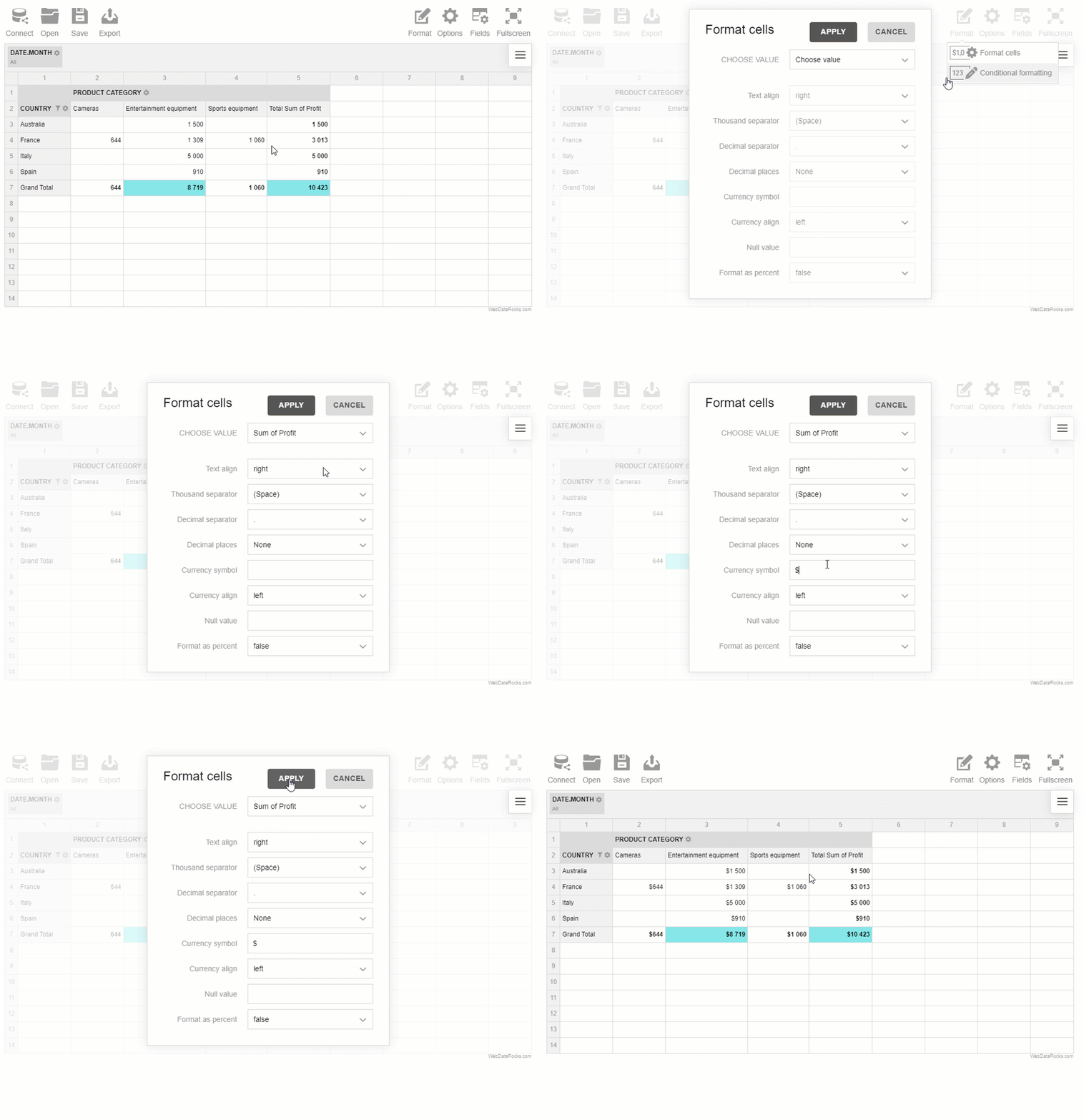
To draw attention to the most important values, we can apply conditional formatting to the cells.

We can format the numbers tidily via the UI as well:
Save the report
Save the tabular report in a JSON file to be able to pick up where you left off later.
Install AnyChart
To get access to charts, we need to add the script file to the <head> section of the page:
<script src="https://cdn.anychart.com/releases/8.6.0/js/anychart-base.min.js" type="text/javascript"></script>
And a container where the chart should be rendered:
<div id="chartContainer"></div>
Process the data
The next step is to transform the data into the format that is suitable for the chart type we are going to use.
Our goal is to write a code which does the following:
- Retrieves the data from the pivot table.
- Processes the data to the appropriate structure.
- Sends this data to the newly created chart.
- Sends updated data to the existing chart if the grid’s report is changed.
But how do we find out when the pivot table is ready to provide the data?
This is where reportcomplete event comes in handy. It’s triggered once the pivot table is rendered and ready to show the report.
Let’s attach an event handler to it and create the function that implements the above-mentioned scenario.
reportcomplete: function() {
pivot.off("reportcomplete");
createPieChart();
}
In createPieChart(), we use webdatarocks.getData() method to request the data from the specified slice and pass it to callbackHandler and updateHandler. callbackHandler defines what should happen as soon as the pivot component is created and the data is ready to be passed. It accepts one argument – a rawData object which has to be processed for the selected type of chart. You can do it by implementing an additional function (e.g. prepareDataFunction()). After the data is prepared, we initialize the chart and fill it with this data.
updateHandler is called once some change occurs in the report (the data is updated/sorted/filtered). We’ll use it for updating the chart’s data at change.
To keep the tutorial brief and simple, we don’t include all code here – please refer to this demo. There you’ll also see how to implement prepareDataFunction().
Results
It’s time to enjoy the results of your great work!
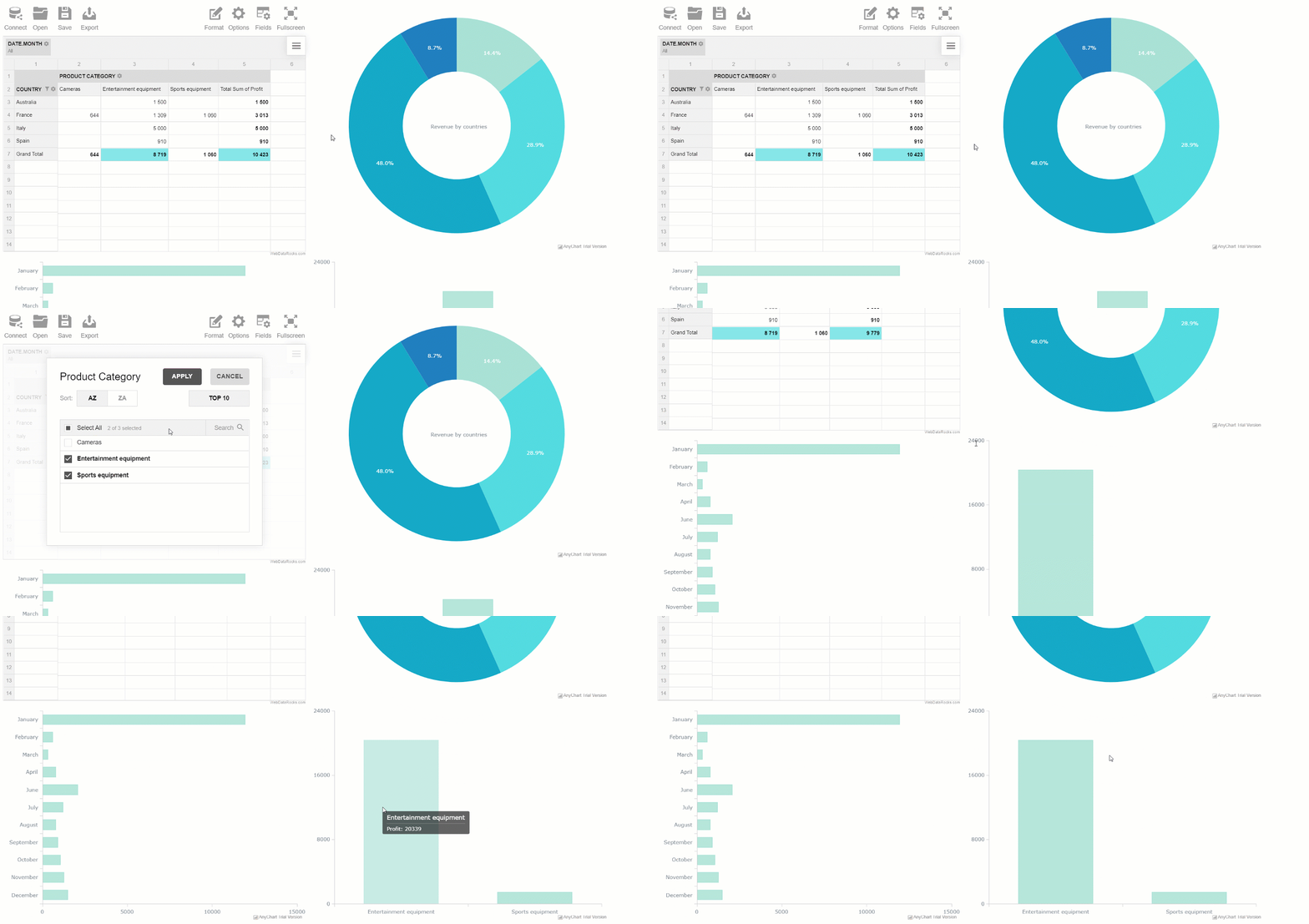
You are ready to use an interactive data dashboard that can assist as a BI tool and provides insights into the levels of profits of a particular company. It looks simple yet it’s very effective when it comes to decision-making.
We encourage you to experiment – change the slice interactively, drill through the values to see which records are hidden behind.
Check out the CodePen demo!
Wrapping it all up
In this tutorial, we learned how to set up a dashboard in your app using JavaScript and two free data visualization libraries that perfectly complement each other – WebDataRocks and AnyChart. We do hope these tools will make a positive impact on decision-making in your business.
Dive deeper
If you have any questions about the structure of a rawData object returned by getData(), please refer to this article.
If you are interested in creating multilevel hierarchies, check out our guide.
In case of any other questions related to WebDataRocks functionality, please post them on StackOverflow.
Do you have a React, Vue or Angular app? Read our available tutorials on integrations.
What else to read?
- Data visualization with WebDataRocks & Chart.js: create a dashboard in 5 min
- Pivot Tables: The Ultimate Guide
- List of best JavaScript components for report application
- Online Reporting: Top Free web-based Pivot Grids that developers will love
- Best Charts to Show Discrete Data
Data visualization is the key 21st-century skill. It’s crucial for making information easier to perceive and holding the interest of an audience longer.
A dashboard is a preferred tool for building effective data visualizations. Dashboards help to fully reveal insights about your data and share them among departments easily. Most often, they present an interactive way to visualize the data and contain charts, graphs, controls, grids, and pivot tables. Such a combination of elements enhances the understanding of the data.
This step-by-step tutorial is aimed at mastering your visualization skills using two free & flexible JavaScript libraries.
Prerequisites
To go through this tutorial, you need to have a bit of understanding of JS and HTML.
What will you get
As a result, you’ll get a dashboard with well-crafted charts and an analytical pivot table, which is ready to be embedded into an app.
Tools for data visualization
The first tool is a pivot table component.

To make your pivot table even more visually appealing, you can customize it:
The simplest way to get started with WebDataRocks is from the integration guide. For React, Angular and Vue developers, there are npm packages available.
The second tool is a charting library.

Being extremely lightweight and responsive, it offers eight basic types of charts: bar, line, pie, radar, polar area, bubble, scatter and area.
What makes this library stand out is its out-of-the-box customization options:
- animations
- layout, legend, and tooltips configurations
- updating colors dynamically
You can find everything about installing it in your project and configuring your first chart in the comprehensible documentation. It covers various aspects of working with charts.
Let’s move on to powering up your project with analytics and visualization!
TL;DR: If you are eager to play with the demo, hop right to the last section with examples.
Prepare your data
Every data visualization starts with the data. Once you’ve collected your dataset, you are ready to move on.
Note: this tutorial is ONLY for plain JavaScript. If your project is based on any of the following frameworks, check our documentation: React, Angular, Vue.
Step 1: Install WebDataRocks
You have three options of adding a pivot table to your project.
- Download a package into your project.
- Use a CDN to add WebDataRocks scripts and styles to your HTML page:
<link href="https://cdn.webdatarocks.com/latest/webdatarocks.min.css" rel="stylesheet">
<script src="https://cdn.webdatarocks.com/latest/webdatarocks.toolbar.min.js"></script>
<script src="https://cdn.webdatarocks.com/latest/webdatarocks.js"></script>
- Install WebDataRocks as an npm package:
npm install @webdatarocks/webdatarocks
Next, add the container where you want to display the pivot table:
<div id="pivot-container"></div>
Initialize the pivot table instance on your page by writing this JS code:
var pivot = new WebDataRocks({
    container: "#pivot-container",
    toolbar: true,
    report: {
        dataSource: {
            filename: "https://cdn.webdatarocks.com/data/data.csv"
        }
    }
});
Step 2: Create a report
Now that you see the pivot table is rendered on the page and filled with data, it’s time to define a slice – a fundamental part of the report that specifies the hierarchies for the rows, columns, and measures. At this step, choose an aggregation function to apply to your measures. You can change it anytime later. If you want to create a custom measure, take advantage of calculated values.
Define a slice like in the snippet below:
"slice": {
    "rows": [{
        "uniqueName": "Country",
        "sort": "asc"
    }],
    "columns": [{
        "uniqueName": "Measures"
    }],
    "measures": [{
        "uniqueName": "Profit",
        "aggregation": "sum"
    }]
}
Step 3: Customizing appearance
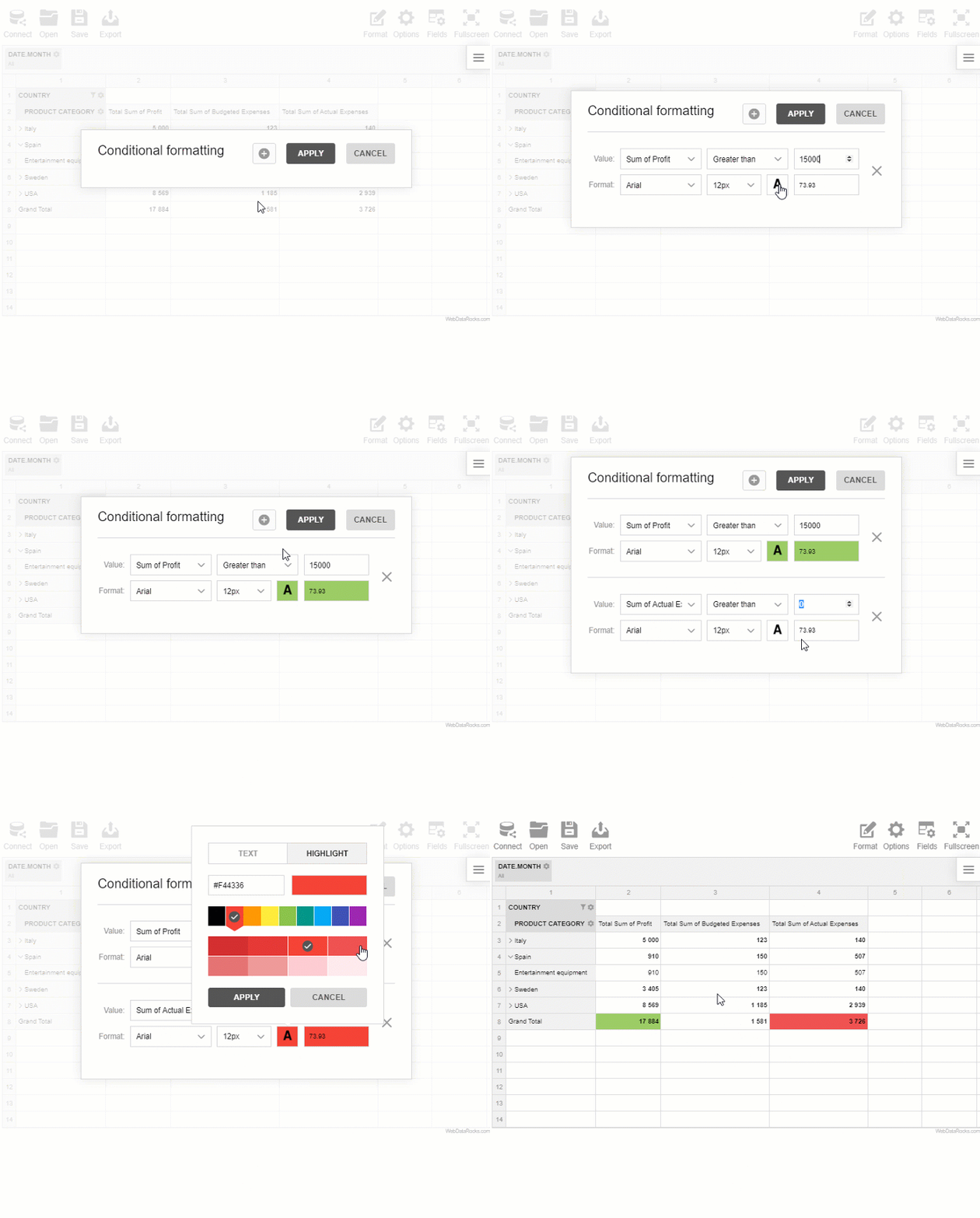
To highlight the values on which you need to focus, apply conditional formatting via UI:
Step 4: Install ChartJS into your project
You have two options of adding this library to your app:
- Use a CDN to add the link to the library to the
<head>section of your HTML page:<script src="https://cdnjs.cloudflare.com/ajax/libs/Chart.js/2.7.2/Chart.js"></>
- Or use an npm package:
npm install chart.js --save
Then, define where the chart will be rendered by adding an HTML5 Canvas placeholder and set the size of this canvas:
<canvas id="polarChart" width="800 height="500"></canvas>
Adding an ID to the canvas element is necessary for the library to know in which container chart will be rendered. When adding multiple charts, every ID must be unique.
Create a canvas context:
var ctx = document.getElementById("polarChart").getContext('2d');
Step 5: Pass the data from the pivot table to the charts
Let’s add a bit of real-time interaction between the components.
We need to do the following: wait until the data is ready, get the data from the pivot table, prepare it to the format required for charts, and create a chart.
Firstly, we get the data from the pivot table as soon as the pivot table is rendered (line 74 in our example):
reportcomplete: function() {
	pivot.off("reportcomplete");
	createPolarAreaChart();
}
The second step is to define createPolarAreaChart() which will get the data we need from the pivot table (line 82 in our example). To achieve that, we used the getData() method. It requests the data from the current report and asynchronously passes this data to callbackHandler and updateHandler. Additionally, you can define which data you’d like to get. callbackHandler should draw the chart and updateHandler should redraw the chart on updates.
The third step is to draw the chart. We prepare the data to the format required for the polar chart (line 121 in our
example), set the necessary options for the chart and render it (lines 122-164).
Final step
Hooray! Now you have a responsive dashboard with data visualization capabilities of charts and pivot table:
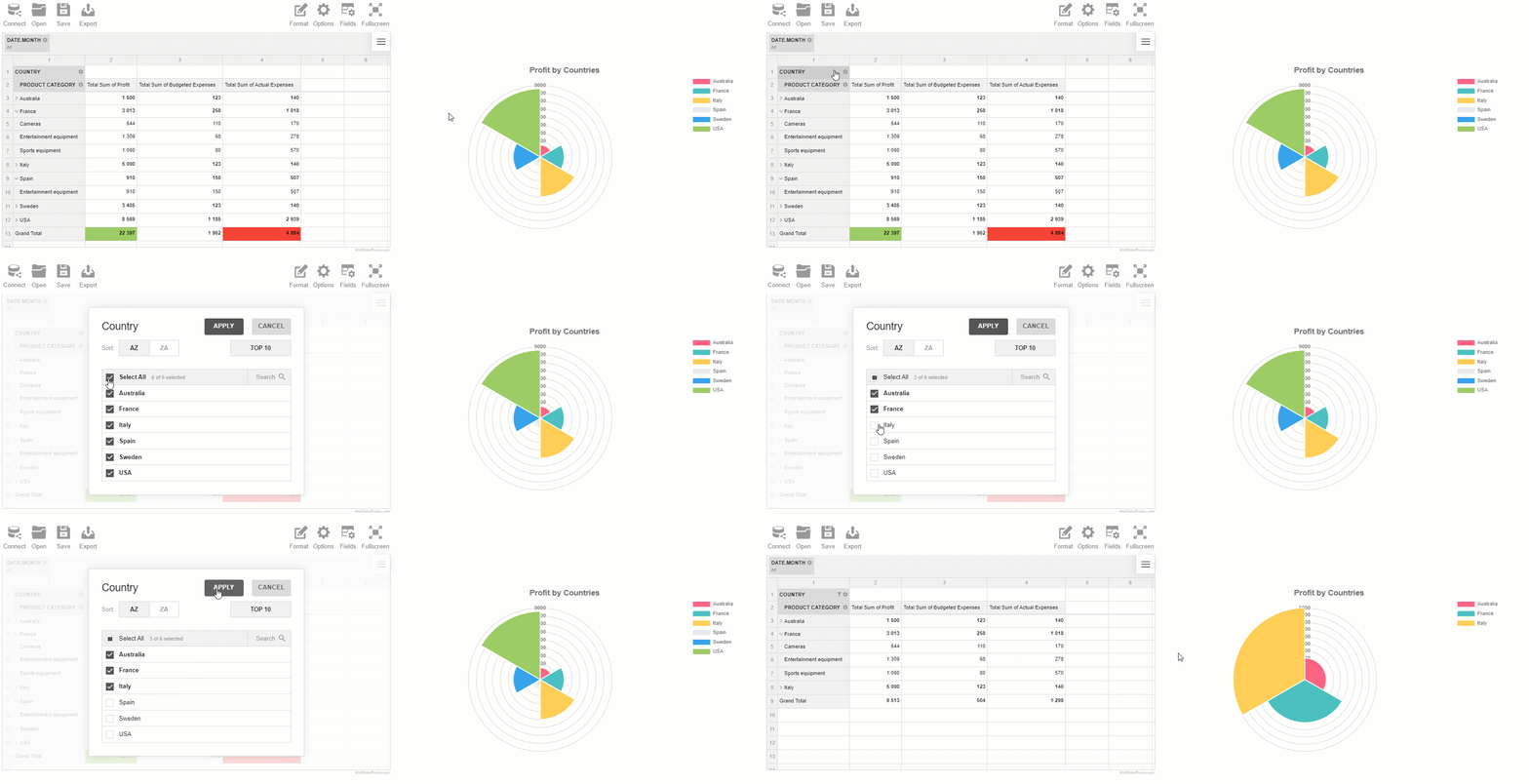
Feel free to embed it into any project and share with your colleagues. Experience real-time interaction: rearrange the hierarchies by using the drag-and-drop feature of the pivot table or set different aggregations. Filter the records and see how immediately the chart reacts to these changes.
Try experimenting to get fabulous results!
Thank you for reading!
Try it on CodePen
Recommended reading
About WebDataRocks:
About Chartjs:
Integration with other charting libraries
If you are still wondering what is the best charting library for you, you can try amCharts, Highcharts, Google Charts and FusionCharts in a combination with WebDataRocks.
- Integration with FusionCharts
- Integration with Highcharts
- Integration with amCharts
- Integration with Google Charts
What else to read?
- Tutorial: How to create a dashboard with WebDataRocks and AnyChart
- Complete Guide to Mobile App Development: Process, Trends, Costs
- WebDataRocks Pivot Grid for Flutter: Integration Guide
- Top resources every developer should read

PHP holds a market share of 49.47%, which sets it as one of the most popular programming languages. With popular languages like Python, JavaScript, Golang, and other languages being developed, the need for PHP still stays. With more than 70% of web pages still developed using PHP, businesses hold on to scripting language to utilize the extensive performance track for PHP.
PHP offers numerous benefits for developers to build superior web applications per the client’s requirements. It is important to choose the right PHP website development company as a key source to develop robust web development solutions.
At a Glance: PHP
PHP works as an open-source scripting language that stands for HyperText Preprocessor. As a widely recognized language, it can be used for developing neoteric web solutions ranging from a simple blogging website to a full-fledged eCommerce website. PHP can be embedded with HTML to develop varied web pages and applications.
High-end brands like Facebook, Tumblr, Wikipedia, Mailchimp, Swiggy, and many more count as users of PHP. Initially, the framework was known as a personal home page, and in later stages, it got a professional name and interface. With 78.9% of businesses using some of the best-known frameworks, Laravel, CodeIgniter, CakePHP, Phalcon, etc.
Latest PHP Development Trends to Look Around
PHP holds a dynamic future in the coming times. With the latest updates and technical advancements, here are some of the latest trends that build around PHP.
Cloud Web Application With PHP
The storage of large data sets is a concern for businesses today. Cloud-based infrastructures are being built by the majority of firms. Various studies found that cloud services and PHP work well together. Due to affordability and the ability to create scalable and secure online applications, PHP tends to be the preferred technology partner.
Voice Search Optimization
Searching via voice is a popular PHP development service. Web designers are integrating speech features into websites as a result of the widespread of digital voice assistants like Amazon’s Alexa and Apple’s Siri. The larger sections of consumers prefer using voice search over writing search queries, as per the surveys. It is possible to develop feature-rich and innovative web applications using the top Frameworks for PHP. There are several PHP frameworks that include a templating engine, which makes it possible to build visually appealing user interfaces.
Creating Smarter Chatbots
Chatbots are the best example of machine-based languages and artificial intelligence that have gained a ranged popularity in recent years. As per the sources, PHP-based tools and frameworks are the best way to build chatbots all due to open-source language that is an easy use for developers.
As an innovative tool that can help in creating user chatbots for websites in a cost-effective manner, a PHP development company can exclusively use the scripting language for “Conversation Agents,” as it impresses with many libraries available for you to choose from the API.
Improved Security Interface of Website
PHP development tools can be utilized to embed robust cybersecurity solutions to secure your web pages effectively. With the gradual change, it has been seen that people prefer online shopping, and with online portals comes the risk of cyberattacks and security breaches. Paytm Wallet, Amazon Pay, and PayPal are some popular mobile wallets that are commonly used by people. If the application of your business is based on mobile commerce, integrating a payment structure gateways works as a secure medium.
Concluding Thought
PHP sets as an easier and cheaper to deploy into compatible servers. At edge, it also holds a server of different scripting languages and operates on Linux and Windows integration without hassles. With its simple and flexible coding interface, a PHP framework is embedded with avant-garde technological developments to date. PHP development services aim to provide powerful server-sides for building web pages and applications effectively.
With the rate of growth, it shows positive signs to rule the web development with its dominant presence. The given trends give a glimpse into the latest on-go dynamic interface that can keep developers connected with transformative technologies.
Thank you our writer author Adam Parker a PHP developer at HTMLPanda. He loves to write and create write-ups that can inculcate PHP-based updates and the latest trends.
What else to read?
- Top Reasons To Choose PHP For Website Development
- What emerging technologies are shaping the future of software development in 2023?
- Web Application Architecture Essence: Selecting the Right in 2022
- Best Programming Languages & Frameworks For Fintech Apps
- Online Reporting: Top Free web-based Pivot Grids that developers will love
- 8 Tips for Choosing the Right Backend Tech Stack for Your Next Project
- How is Laravel Revolutionizing the Way Enterprises Develop Applications?

In the ever-evolving software development landscape, having the right backend tech stack for your project is pivotal. Your choice can significantly impact the project’s delivery, performance, scalability, security, and success.
According to Sytian, a leading web designer philippines company with expertise in web app and software development – tech stack is basically the tools you will use for your product development. It is an array of programming languages, frameworks, libraries, APIs, and more, is the foundation upon which you and your team members will build your software product.
In this article, we’ll explore eight essential tips to guide you in making the most informed decisions on choosing your tech stack.
What is a Tech Stack?
A tech stack, or technology stack, represents the combination of tools and technologies developers use to create a software solution.
The tech stack has two main components: the client side and the server side. The client-side, or frontend, pertains to what the user interacts with, while the server-side, or backend, manages data, processing, and server operations.
Choosing the right tech stack is a critical early step in the development process.
Let’s begin!
1. Project Requirements
Defining project requirements is essential to begin with. Selecting the right tech stack for your software project starts with a comprehensive understanding of its unique requirements.
It’s important to consider factors such as the scope of functions, application size, and complexity to make an informed choice.
Building a Minimum Viable Product (MVP) can be a practical approach if you’re looking to test or validate an idea. A small MVP developed with open-source Content Management System (CMS) technology can be a cost-effective and efficient way to test the feasibility of your concept.
Considering these factors, you can make an informed decision and choose a tech stack that meets your project’s needs.
2. Scope of Project
Regarding smaller-scale projects, delivery speed can be a top priority, often taking precedence over advanced technologies and frameworks.
In such cases, building a Minimum Viable Product (MVP) quickly may be an attractive option to present to the customer and obtain valuable feedback.
Utilizing simple tools and open-source platforms can help you achieve this goal effectively. Opting for simpler technologies can save time and money while still delivering a functional product.
This approach may benefit startups and small businesses looking to test the waters with a new idea or concept. Often, MVPs are also used in getting funding for a project.
3. Scalability and Flexibility
Thinking ahead to your project’s long-term goals is crucial. Consider whether you will need to scale the application in the future or integrate it with other systems or technologies.
Selecting a tech stack with scalability and flexibility ensures your system can adapt to changing business requirements and user needs. It keeps you ahead of the competition and enhances the user experience.
Opting for a cloud-ready tech stack can save you time and resources by reducing the need for on-premise infrastructure and facilitating easy scaling.
4. Security and Privacy
In the digital age, ensuring the security and privacy of your application and its users is paramount. While no technology can guarantee absolute protection, you should be discerning about the technologies and practices you implement to safeguard data.
Choose frameworks that regularly release updates and provide additional support, as this can help protect your application from emerging threats.
Consider implementing security tools such as static vulnerability analysis tools (SAST), vulnerability scanners, container analysis, and dependency analyzers to enhance your project’s security posture.
5. Development Time
Time to market is often a crucial concern for businesses. To expedite development, consider a tech stack where the front and backend technologies are aligned.
Using JavaScript throughout the tech stack can streamline development, as it allows for full-stack development and easy data exchange between client and server.
You can take this further by using a JSON-Object-based database like MongoDB, further simplifying development and data management.
Always consult with a senior team member to come up with a timeline. Consider this step an integral component of the project’s discovery phase. Calculate the necessary hours for each endeavor and meticulously document them, as this information will prove valuable in the subsequent stages of the project.
6. User’s Experience
A positive user experience is crucial for any software project’s success. That’s why selecting a tech stack that enhances the user experience while enabling rapid product upgrades is essential.
Delivering a high-quality experience and promptly gathering user feedback for product enhancements can set your project apart in a competitive landscape.
By prioritizing user experience, you can create an intuitive, easy-to-use product tailored to your target audience’s needs. Users are more likely to return to a product that provides a positive experience, leading to increased engagement and higher customer satisfaction.
Therefore, choosing a tech stack that prioritizes user experience and enables quick upgrades to meet evolving user needs is important.
7. Cost Implications
When selecting a tech stack, being mindful of the financial aspect is crucial. Not all technologies are open-source, and licensing costs can vary, making it difficult to predict the overall project cost. That’s why it’s wise to outline a budget you’re willing to allocate for your tech stack.
This proactive approach helps prevent financial issues and ensures that your project remains on a stable financial footing. By setting a budget early on, you can make informed decisions about the technologies and tools you use in your project.
Getting honest with the budget can help you avoid unexpected costs and ensure that your project is financially sustainable in the long run.
8. Development Team Expertise
The skills and experience of your development team play a significant role in tech stack selection. Ensure that your team possesses the expertise to work with the chosen technologies and tools.
Evaluate their familiarity with the selected stack, as a skilled team can significantly impact the project’s efficiency and success.
Conclusion
Choosing the right backend tech stack for your project is a crucial decision that can influence its performance, scalability, security, and overall success.
By carefully assessing project requirements, considering scalability, prioritizing security, and aligning your tech stack with your development team’s expertise, you can set your project up for success. Keep the user experience and budget in mind and stay agile to adapt to future needs.
Ultimately, your tech stack should be a strategic asset that empowers your project to thrive in a dynamic digital landscape.
Thank you our writer Lili Griffin a Web Developer and Adwords specialist by day and a binge Netflix watcher at night.
What else to read?
- .NET Development in the Backend – What’s the Best Option for the Front-End
- 9 Tips to Ensure a Successful Data Warehouse
- Web Application Architecture Essence: Selecting the Right in 2022
- Selecting the Tech Stack for the Web Architecture: Innovative Tools for the Successful Product
- Top resources every developer should read
- Developer’s choice: an overview of the best front-end frameworks in 2020
- Best Code Editors For Web Development – The Ultimate Latest List

Today, businesses look for novel methods to improve consumer experiences, optimize processes, and maintain competitiveness. In order to accomplish these goals, application development is essential, and Laravel is a potent PHP framework that has revolutionized the field.
Hire dedicated Laravel app developers who use special features such as routing options, session management, verification, capture, etc., for transforming enterprise web applications. Because of its templates, functionalities, and simplicity of use, Laravel is a favorite among most developers.
Additionally, Laravel is the preferred framework for the majority of PHP programmers. Here, you will see the way businesses create applications is changing because Laravel has powerful capabilities and a developer-friendly approach, which are listed in this article.
But what is Laravel?
Modern PHP applications can be built using tools and resources provided by the free and open-source Laravel framework. With a full ecosystem utilizing its built-in capabilities and a range of compatible packages and extensions, Laravel has witnessed a sharp increase in popularity in recent years, with many developers choosing it as their go-to framework for an efficient development process.
Websites, online stores, ticketing systems, dashboards, ordering platforms, and administrator backends for real-time web applications all use it.
The framework was made for growth and is very scalable. Laravel incorporates the greatest features of numerous web frameworks, including those built using entirely different programming languages.
Tips on how Laravel is transforming the development of Enterprise applications:
- Effective ORM for rapid development:
Database administration is made easier by Laravel’s Eloquent Object-Relational Mapping, which enables developers to communicate with databases using an easy-to-use syntax. This functionality substantially speeds up application development for businesses.
With Laravel handling the core database processes, Laravel developers can concentrate on business logic and functionality. For enterprise applications, this leads to shorter development cycles and speedier time to market.
- Open-source:
Laravel is an open-source, free framework that may be used by commercial organizations wishing to invest in a web application. Its popularity among developers is partly due to its advanced features.
An open-source framework has several advantages, including no license fees and being modified to meet specific project needs.
You are all well aware of how different aspects of a business determine how an enterprise application must function. Laravel is your best option in that circumstance.
- Highly-secure:
Laravel is a very secure PHP framework that prevents any attempts by malware from infiltrating the web application. It protects website data and code from all types of hacking activities. Your web application will be secure against cyberattacks if you employ a dedicated Laravel developer. The excellent performance of Laravel’s web applications is another benefit.
It makes use of several tools to assist the developers in enhancing the functionality of web applications. That means if a business uses the Laravel framework to create a web application, it will perform far better than other web apps.
- Modern Architecture:
As a result of their diverse business requirements, businesses usually seek complex, feature-rich applications. Laravel’s modular architectural approach makes building scalable and simple-to-maintain applications easier.
Laravel equips developers to break down large projects into more manageable, reusable components by leveraging technologies like Composer for effective package management. The organization of the code is improved by this modularity, which also encourages more effective team cooperation.
Large-scale corporate projects are subsequently much easier to manage, allowing teams to collaborate effectively and create sophisticated, adaptive solutions that perfectly match the enterprise’s changing needs.
- Effortless Data Migration:
It is a difficult task to do database migration for transforming web applications. When given the duty of database migration, even the most experienced developers need help with difficulties. As a business owner, you may want a database migration service to develop an enterprise application.
It is crucial to hire a Laravel development company with the tools necessary to increase the database structure without starting from scratch to handle situations like this. As a result, there is a far lower chance of losing any crucial data.
- Scalable and performance optimization:
The need for reliable applications increases as businesses grow. To properly satisfy these expanding needs, Laravel is a PHP framework that provides remarkable scalability features. In order to handle increasing workloads across several servers, it supports distributed systems.
While content caching speeds up response times by saving frequently accessed material, database clustering ensures data performance and dependability. Hire dedicated Laravel app developers who use performance-enhancing techniques that only load resources when required and query optimization, which optimizes database queries for effectiveness.
The combination of these strategies helps to make faster response times and a more seamless user experience possible.
- Robust testing and debugging:
It is essential to guarantee top-notch quality when developing enterprise applications. As a PHP framework, Laravel goes above by offering a full complement of testing tools and a very clear syntax for creating test cases.
The duty of development teams in confirming the dependability and stability of their apps is made easier by this potent combination. Laravel’s skillful error handling and strong logging features further stream the debugging process.
This improves the enterprise system’s overall resilience and dependability by decreasing downtime and the negative effects of problems in production situations.
- Unit testing infrastructure:
Any process used to develop a web application is lacking without adequate testing. Before the application’s official release, testing it once the coding is complete is crucial. The web application’s performance, speed, and security will be evaluated.
Django vs. laravel 2023 is more appropriate for huge, complicated projects, whereas Laravel is more typically selected for smaller, lighter applications.
Any programming framework you use nowadays will have a variety of development tools. However, Laravel is one of the few frameworks that can be tested. You don’t need to test the web application separately because it can run numerous unit tests.
Summing it up
In developing enterprise applications, Laravel has grown to be a formidable force. You will learn how businesses create and manage their apps is changing due to its modular architecture, security features, support for APIs, testing tools, scalability choices, and active community.
Laravel has contributed to change in enterprise application development that is expected to become even more significant in the upcoming years. Hire Laravel experts who are better equipped to address the evolving needs of the digital ecosystem and provide their customers with enhanced experiences.
Thank you to our guest author Maulik Shah, CEO of BiztechCS. He often takes the front seat in the company’s development projects as he enjoys solving problems through technology. Maulik ensures that his interaction with development is frequent enough, and his industry knowledge is ever-evolving so that he can share it.
What else to read?
- List of Top Database Management Software
- How data visualization transforms the way you do business
- Top 11 splendid data visualization blogs to follow in 2020
- Best JavaScript frameworks for 2021
- Top resources every developer should read
- Developer’s choice: an overview of the best front-end frameworks in 2020
- Best Code Editors For Web Development – The Ultimate Latest List

The Paradigm Shift to Data-Driven Decision-Making
We are living in an era of big data, where data-driven decision-making has become a pivotal part of business operations. From healthcare to retail, industries across the board are leveraging data science to refine their strategies, optimize resources, and predict future trends. However, abstract concepts and theories often fail to convey the true potential of data science projects. Therefore, examining real-world case studies and their practical applications can provide a more tangible understanding of data science in action.
Predictive Analytics in Healthcare
One of the primary applications of data science is in the healthcare industry. By employing predictive analytics, medical professionals can anticipate disease outbreaks, improve patient care, and optimize resource allocation. A case in point is the use of machine learning to predict diabetes in patients.
The Center for Disease Control and Prevention (CDC) conducted a project to predict diabetes in individuals based on various factors like age, BMI, insulin level, and family history of diabetes. They developed a predictive model using various machine learning algorithms. This model was able to accurately predict individuals at high risk of developing diabetes, thus enabling early intervention and preventive care. The use of such data-driven models can not only improve patient care but also reduce healthcare costs significantly.
Retail and E-commerce Analytics
Data science has revolutionized the retail and e-commerce industry by providing insights into customer behavior, optimizing pricing strategies, and improving supply chain management. Amazon, one of the largest e-commerce companies, harnesses the power of data science in numerous ways.
Amazon’s recommendation system is a perfect example of a data science application. The company uses collaborative filtering, a machine learning technique, to predict a customer’s preferences based on their past behavior as well as similar customers’ behavior. This personalized recommendation system has significantly boosted Amazon’s sales, proving the efficacy of data science in enhancing customer experience and driving business growth.
Traffic Management and Urban Planning
Data science is also playing an essential role in improving urban planning and traffic management. A remarkable example is the Google-owned company, Waze. This GPS navigation software app uses real-time traffic data from its community of users to provide the fastest possible routes to destinations.
The app collects data on users’ speed, location, and route and uses these insights to inform other users about the quickest and most efficient routes. This real-time data analysis not only saves time for individual drivers but also has wider implications for urban planning and reducing carbon emissions.
Educational Pathways for Aspiring Data Scientists
Aspiring data scientists often question the best way to get a foot in the door of this exciting field. Quality education and practical exposure to real-world projects are essential components of a comprehensive data science education.
One resource that offers a solid foundation is the MIT Applied Data Science Program. This rigorous and well-structured program equips students with the necessary theoretical knowledge and practical skills to tackle real-world data science problems. It offers a comprehensive curriculum covering data collection, analysis, visualization, and interpretation, all critical skills for budding data scientists.
Bridging the Gap with Online Courses
While formal education lays the groundwork, supplementary resources can enhance learning and provide practical exposure to diverse data science applications. Online courses are an excellent way to bridge this gap.
Enrolling in a comprehensive Data Science Course can be particularly beneficial. These courses typically encompass a wide array of topics, including machine learning, statistics, Python programming, and more. They also often provide real-world projects to work on, enabling students to apply the theoretical knowledge they have gained.
Impact of Data Science on Finance
Adding another significant feather to its cap, data science has made a significant impact in the financial sector. The complex and voluminous data in this industry necessitates advanced tools and techniques to extract valuable insights. This is where data science steps in.
For example, American Express, a multinational financial services corporation, leverages big data and machine learning to predict potential churn and fraud. They analyze structured (transaction details) and unstructured data (social media interactions) to develop predictive models. These models help identify potential customer churn before it happens and detect fraudulent transactions, ensuring a seamless customer experience while minimizing loss for the company.
Data Science in Sports Analytics
The influence of data science has extended to the world of sports as well. Sports teams and franchises use data science techniques to improve their strategies, optimize player performance, and enhance injury management.
The NBA team, Houston Rockets, is a pioneer in leveraging data science for game strategy. They use analytics to determine the most efficient shots on the basketball court and develop their offensive strategy accordingly. Furthermore, they analyze player data to manage player fatigue and prevent injuries, showcasing another practical application of data science.
Data Science and Social Impact
The extent of data science is not solely confined to business applications. It also plays a pivotal role in tackling societal problems and creating a beneficial influence. Data science has the capability to recognize patterns and tendencies in domains like criminal activity levels, economic hardship, and community well-being, thus providing valuable insights for implementing effective approaches to combat these obstacles.
One such instance is the use of data science to fight hunger in developing countries. The World Food Programme uses data analysis to identify regions most affected by food scarcity and optimize the allocation of resources. By predicting potential crisis zones, data science can assist in more targeted interventions and proactive problem-solving.
The Predictive Intelligence in Manufacturing Efficiency
General Motors’ Predictive Maintenance
General Motors is utilizing data science to predict potential failures in machinery and reduce downtime in its manufacturing processes. With thousands of sensors monitoring the condition of equipment, real-time data is analyzed through machine learning algorithms to predict when a machine is likely to fail. This has enabled GM to perform maintenance proactively, minimizing production delays. The system’s significant reduction in unexpected equipment failures is enhancing overall efficiency and cost reduction, transforming the way manufacturing industries operate. By adding a layer of intelligence and foresight, GM showcases how data science can drive innovation and efficiency in manufacturing.
The Customized Approach to Tourism and Hospitality
Marriott’s Personalized Guest Experience
Marriott Hotel Chain uses data science to provide personalized services and offers to guests based on their preferences and behaviors. From room selection to dining preferences, data-driven insights are used to curate a unique experience for each guest. The personalized approach extends to Marriott’s mobile app, where guests receive tailored recommendations and can select specific rooms. The marriage of data science and hospitality has not only led to increased customer satisfaction and loyalty but has also set a new standard for guest experience, proving that data can be a game-changer in customer service industries.
Do you want to be the first to test the grid with your data?
The Integrated Governance in Singapore’s Smart Nation Initiative
Singapore’s Data-Driven Public Transportation
Singapore’s government has embraced data science through its Smart Nation Initiative, leveraging data to optimize public transportation, environmental monitoring, and urban planning. The data-driven approach has significantly reduced congestion and improved commuter experience, promoting sustainable urban living. Singapore is also applying these methods to other areas such as healthcare, safety, and governance. By integrating data across various public domains, Singapore is pioneering a new era of efficient, responsive governance, serving as a global example of how data science can revolutionize public administration and enhance the quality of urban life.
The Personalized Entertainment Experience on Netflix
Netflix’s Recommendation Algorithm
Netflix’s streaming services are shaped by data science, using machine learning to analyze viewing habits, ratings, and user interactions to offer personalized recommendations. The success of this recommendation system has had a profound impact on subscriber retention and content engagement. By continuously learning from user behavior, the algorithm evolves, offering more precise suggestions over time. This targeted approach ensures that viewers find content that resonates with them, leading to increased watch time and customer satisfaction. Netflix’s case study underlines the influence of data science in reshaping the media and entertainment landscape, making content consumption more personalized and engaging.
The Data-Driven Approach to Environmental Conservation
Wildlife Protection through Data Analysis
Worldwide conservation organizations, including the WWF, are employing data science to protect endangered species and preserve biodiversity. By using camera traps and sensors to monitor wildlife and environmental conditions, these organizations can analyze vast amounts of data to guide conservation strategies and timely interventions. Beyond informing local actions, these insights are contributing to global knowledge and collaboration on conservation issues. The innovative use of data science in wildlife protection demonstrates its potential to have a meaningful social impact, moving beyond commercial applications and contributing to the global effort to preserve our planet’s biodiversity and ecological balance.
The Transformation of Agricultural Efficiency through Data Science
John Deere’s Precision Farming
John Deere’s embrace of data science has revolutionized farming practices, making agriculture more sustainable and efficient. By integrating data analytics and IoT devices into farming equipment, they have enabled farmers to monitor and manage their machinery and crops in real-time. These insights are used to optimize planting times, soil management, and irrigation, resulting in more productive yields and reduced waste. Additionally, predictive analytics helps farmers to anticipate machinery breakdowns and mitigate potential problems. John Deere’s case exemplifies how data science can transform traditional industries, marrying technology with age-old practices to usher in a new era of agricultural innovation.
The Advancement of Personalized Medicine with Data Analytics
23andMe’s Genetic Insights
The personal genomics company 23andMe uses data science to provide individuals with insights into their genetic heritage and potential health risks. Through genetic testing and sophisticated data analysis, the company offers personalized reports on ancestry, wellness, and predisposition to specific diseases. This information empowers individuals to make more informed healthcare decisions and encourages a more personalized approach to treatment and prevention. The marriage of genetics and data science in 23andMe’s offerings exemplifies a profound shift in healthcare towards personalized medicine, highlighting the potential of data to revolutionize medical understanding and patient care.
The Enhancement of Law Enforcement through Predictive Policing
Los Angeles Police Department’s Operation LASER
The Los Angeles Police Department (LAPD) has implemented a data-driven program known as Operation LASER to predict and prevent criminal activity. Using historical crime data, social media monitoring, and spatial algorithms, the system identifies crime hotspots and predicts potential criminal activities. Officers receive real-time insights that guide patrol routes and investigative priorities. This approach has led to more proactive policing, helping reduce crime rates in targeted areas. The LAPD’s use of data science showcases the transformative potential of predictive analytics in law enforcement, leading to more efficient resource allocation and a proactive approach to community safety.
The Reinvention of Customer Support with AI and Data Analysis
IBM’s Watson in Technical Support
IBM has leveraged its AI system, Watson, to reinvent customer support, especially in complex technical domains. Watson can analyze vast amounts of data, including product manuals, support documents, and customer interaction logs, to understand and solve customer issues. By combining natural language processing and machine learning, Watson offers real-time assistance to support agents, suggesting solutions and even interacting directly with customers through chatbots. This data-driven approach has dramatically reduced response times and increased customer satisfaction rates. IBM’s integration of AI and data science into customer support showcases the potential to enhance efficiency and customer experience in service industries, offering a glimpse into the future of human-AI collaboration.
Deepening Knowledge through Certifications
As data science continues to penetrate various sectors, the demand for skilled data scientists is on the rise. Supplementing your knowledge with certifications can give you an edge in the competitive job market.
Specifically, earning a Data Science Certification can help you demonstrate your expertise and commitment to prospective employers. It can validate your skills, showcase your knowledge of cutting-edge data science tools and techniques, and help you stand out in the crowd.
Final Thoughts
From healthcare to finance, retail to sports, and even social impact initiatives, the potential applications of data science are broad and diverse. The need for professionals with a firm grasp of data science concepts and the ability to apply them in real-world scenarios is growing exponentially. Educational programs such as the MIT Applied Data Science Program, supplemented with online courses and professional certifications, can provide an ideal pathway to enter and thrive in this dynamic and rapidly evolving field. The future is data-driven, and data science is leading the way.
Thank you to our guest author Nisha Nemasing Rathod, a Technical Content Writer at Great Learning. She focuses on writing about cutting-edge technologies like Cybersecurity, Software Engineering, Artificial Intelligence, Data Science, and Cloud Computing and holds a B.Tech Degree in Computer Science and Engineering . She is a lifelong learner, eager to explore new technologies and enhance her writing skills.
What else to read?
- List of Top Database Management Software
- How data visualization transforms the way you do business
- Top 11 splendid data visualization blogs to follow in 2020
- Best JavaScript frameworks for 2021
- Top resources every developer should read
- Developer’s choice: an overview of the best front-end frameworks in 2020
- Best Code Editors For Web Development – The Ultimate Latest List